What is SEO? The Complete Guide to Search Engine Optimization (2026)

Your no-fluff guide to search engine optimisation — from absolute basics to advanced strategy, written for real marketers.

1. What Is SEO — And Why Should You Actually Care?

Search engine optimization — SEO for short — is basically the practice of getting your website to show up when people search for stuff on Google. That’s it, at the core. Everything else is detail.

Here’s what SEO isn’t, though. It’s not magic. It’s not something you set up once and walk away from. And no, it’s not reserved for big brands with six-figure marketing budgets — small businesses win at this all the time. What it actually is: a slow, ongoing grind of making your site more relevant, more trustworthy, and easier for Google (and real humans) to understand.

Say someone searches “digital marketing course near me” or “how to run Facebook ads.” Whether your site shows up on that first page or gets buried on page 7 comes down almost entirely to SEO — how relevant your content is, how well it’s structured, whether Google trusts your site enough to recommend it.

And this isn’t a minor channel you can ignore. Organic search sends more traffic to websites than social media, email, and paid ads combined, over time. Skip SEO, and you’re basically opening a shop in the middle of a busy market with no sign outside. You exist. Nobody can find you.

Let’s Break Down the Term Itself

SEO stands for Search Engine Optimization. Split it into its three parts and it actually explains itself:

  • Search — whatever someone types into a search bar. Could be three words, could be a whole question.
  • Engine — the platform where that search happens. Most people think “Google” first, and fair enough, but Bing and Yahoo count too — and so does YouTube, Instagram, Amazon, or Facebook, since they all have their own internal search functions people use constantly.
  • Optimization — the actual work of shaping your website or content so it lands near the top when someone searches on any of those platforms.

Put it together and you get the textbook version: SEO is the practice of optimizing web pages — or an entire site — to make them more search-engine-friendly, so they rank higher in results. Under the hood, this breaks down into a few core techniques.
Real talk: The top 3 results on Google capture over 54% of all clicks. Position 4 onwards gets scraps. If you are not on page one, most of your potential audience never finds you — no matter how good your content is.

SEO and Digital Marketing — How They Fit Together

Here is where a lot of people get confused. SEO is not separate from digital marketing — it is one of its most powerful pillars. Think of your digital marketing strategy as a table. Paid ads (SEM), social media, email marketing, and SEO are the four legs. Remove any one of them, and the table wobbles. It is one of the crucial part of digital marketing stratergy.

SEO specifically handles organic search — the results Google shows without you paying for each click. SEM (Search Engine Marketing) covers the paid side — Google Ads, Bing Ads, shopping campaigns. Both matter. But SEO compounds over time in a way paid ads never do. A well-optimised article can bring you traffic every single day for years. An ad stops the moment your budget runs out. SEO are done keep long term organic traffic to the website.

2. How Search Engines Actually Work

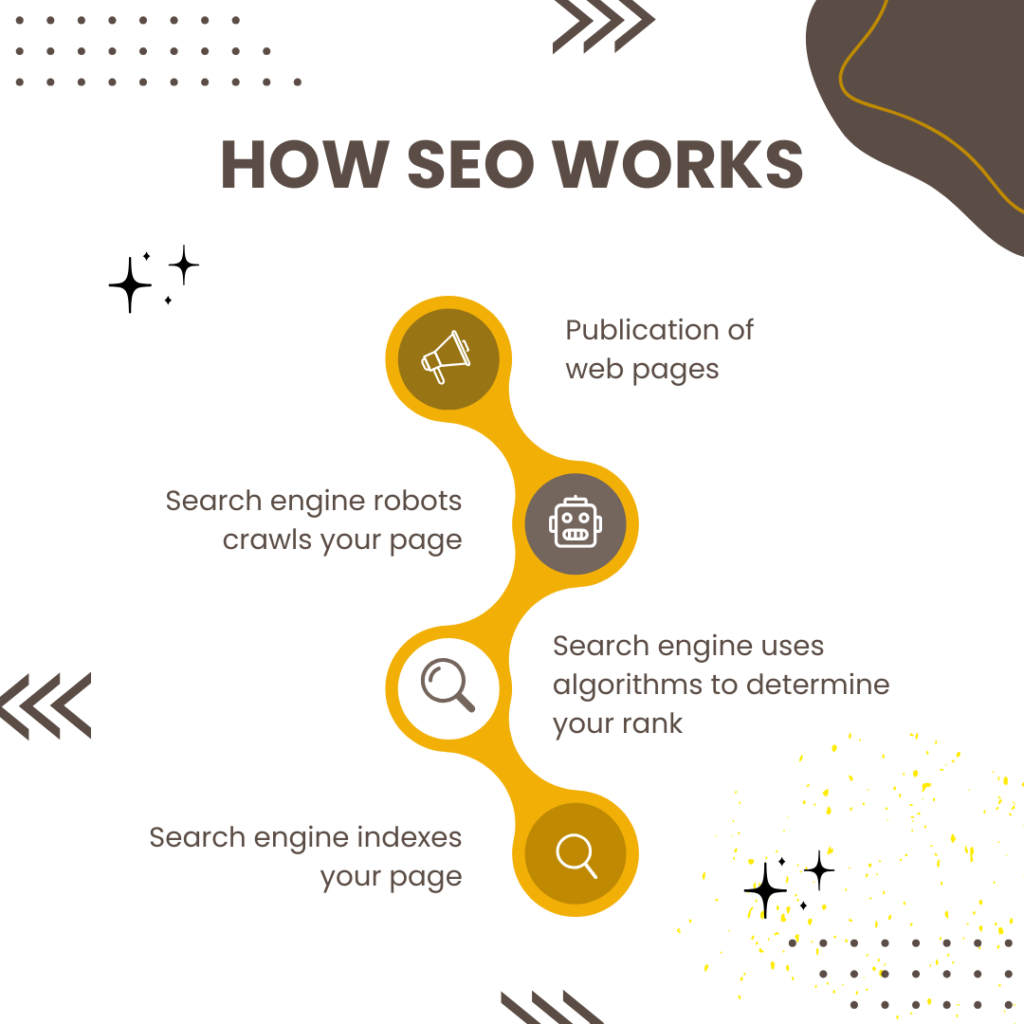
Before you can optimise for Google, you need a mental model of what Google is actually doing. Most people picture it as a librarian with a giant index of books. That is not far off — but there are three distinct jobs happening behind the scenes.

Crawling — Google Reads the Web

Google sends out automated bots called crawlers (or spiders). These bots follow links from page to page, reading content, noting updates, and discovering new URLs. They are always running — every minute of every day.

The implication for you: if your pages are not linked to from anywhere, crawlers may never find them. Internal linking — connecting your pages to each other — is not just good UX. It is how you make sure Google knows your content exists.

Indexing — Google Stores What It Finds

Once a page is crawled, Google decides whether to add it to its index — a database of hundreds of billions of web pages. Not everything makes it. Thin content, duplicate pages, pages blocked by robots.txt, and slow-loading pages often get skipped or de-prioritised.

Ranking — Google Decides the Order

When someone searches, Google’s algorithm instantly evaluates every indexed page relevant to that query and ranks them. This is where the real competition happens. Google uses over 200 ranking factors — but they all essentially boil down to three things:

  • Relevance: Does your content actually answer the query?
  • Authority: Do other credible sites link to and reference your content?
  • Experience: Is your site fast, safe, and easy to use on mobile?

Master these three and you will rank. Ignore any one of them and the other two cannot save you.

Quick check: Go to Google and type site:yourdomain.com — the number of results shown tells you roughly how many of your pages are indexed. If you have 50 pages on your site and only 10 show up, you have an indexing problem worth fixing.

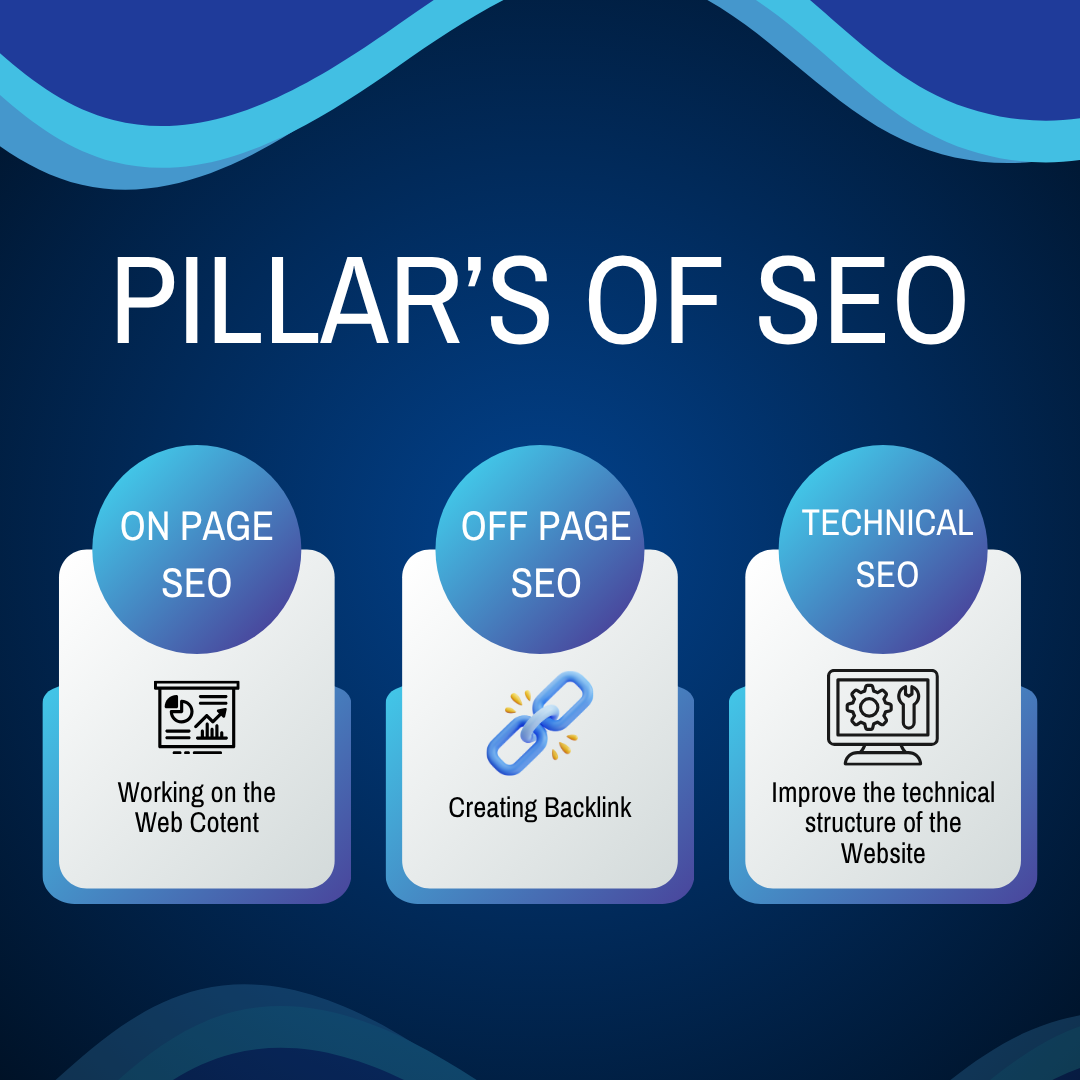
3. The 3 Pillars of SEO

Every SEO activity you will ever do falls into one of three buckets. Understanding this structure is what separates people who do SEO randomly from those who do it systematically.

On-Page SEO — What You Write and How You Structure It

On-page SEO is about making each page on your site as clear and relevant as possible for both Google and your readers. It starts with content — but content alone is not enough. How you structure, tag, and optimise that content is equally important.

Title Tags

Your title tag is the blue clickable headline in Google search results. Keep it under 60 characters. Put your primary keyword near the front. Make it compelling — people need to want to click it.

Example: Instead of “Home | Open Digital Resources”, write “Free SEO & Digital Marketing Guides | Open Digital Resources”

Meta Descriptions

Meta descriptions do not directly affect rankings — but they affect click-through rates, which do. They influence the user to click the link to read the blog or article. Write well-optimised content of 150–160 characters that summarises the page and gives someone a reason to click. Think of it as a mini ad for your content.

Heading Structure (H1, H2, H3)

Use one H1 per page — your main title. H2s for major sections. H3s for sub-points within sections. This is not just for Google; well-structured headings make your content scannable and easier to read.

LSI Keywords and Semantic Coverage

LSI keywords (Latent Semantic Indexing) are terms related to your main keyword sometimes they are synonyms too. If you are writing about “on-page SEO”, LSI keywords would include things like title tags, meta descriptions, internal linking, and keyword density. Google uses these to understand the full context of your content — not just whether the exact keyword appears.
You do not need to force LSI keywords in. Write naturally and cover a topic thoroughly, and they will appear on their own.

Internal Linking

Every page you publish should link to at least 2–3 other relevant internal pages on your site. This does two things: it helps users navigate and discover more content, and it passes authority (called link juice) between your pages. Thus improving ranking and visiblity improving ranking and visibility on search engines.

Pro tip: Your most important pages should receive the most internal links. If your SEO pillar page is the hub, every blog post in your SEO cluster should link back to it.

Off-Page SEO — Building Authority Beyond Your Website

Off-page SEO is primarily about backlinks — links from other websites pointing to yours. Every backlink is effectively a vote of confidence. Google treats sites with more high-quality backlinks as more authoritative and trustworthy. It is also a reflection of how popular your website is.

The keyword here is quality. The focus should be on the quality of the link rather than the quantity. One link from a respected industry site — a university, a major news outlet, a well-known marketing blog — is worth more than 100 links from random low-quality directories. Buying cheap backlinks is a shortcut that often ends in Google penalties.

How to Build Backlinks That Actually Work

  • Write genuinely useful content people want to reference and share
  • Reach out to industry bloggers and offer guest posts on relevant topics
  • Use HARO (Help a Reporter Out) — journalists actively look for expert sources and will link to your site in return
  • Create original research, surveys, or data studies — these attract natural links
  • Get listed on industry directories, partner websites, and resource pages

Technical SEO — The Foundation Everything Sits On

Technical SEO is sometimes considered a subset of on-page SEO, but most practitioners treat it as its own distinct pillar. Technical SEO is the part most beginners ignore and most experienced marketers wish they had started earlier. If your site is slow takes a long time to load, is not mobile-friendly, or has indexing and crawling issues, all your content and link-building efforts are working against a headwind.  Getting your technical foundation right from the start saves significant time and ranking potential down the line.

  • Core Web Vitals: Google’s user experience metrics — Largest Contentful Paint (LCP), Interaction to Next Paint (INP), and Cumulative Layout Shift (CLS). Check yours in Google Search Console.
  • Mobile-first indexing: Google primarily crawls and ranks the mobile version of your site. If your mobile experience is poor, your rankings will reflect it.Always test your site across screen sizes before publishing.
  • Page speed: Pages should ideally load in under 2.5 seconds. Thoses pages perform significantly better Use Google PageSpeed Insights, Pingdom or GTmetrix to identify and fix bottlenecks.
  • XML sitemap: Submit one to Google Search Console so crawlers can find all your pages efficiently .Allowing crawlers to visit your site and crawl all avaialable pages, ensuring every published page is discoverable and eligible for indexing.
  • Schema markup: Structured data tells Google exactly what your content is — an article, a course, an FAQ, a review. It can unlock rich results in search (star ratings, FAQs, breadcrumbs).

    This additional context helps Google display more informative, visually enhanced listings in search results.

4. Keyword Research — Finding the Words Your Audience Uses

Keywords are the backbone of SEO. They are the actual words and phrases people type into Google when they are looking for something. If you are not targeting the right keywords, you can write brilliant content and still attract zero visitors — because nobody is searching for the words you used.

Good keyword research is not about finding the most-searched terms and stuffing them in. It is about understanding what your audience is actually looking for, what language they use, and what they need help with.

Search Intent — The Thing Most People Miss

Two people can type different searches and want the exact same thing. Or type similar searches and want completely different things. Search intent is the why behind a query — and matching your content to the right intent is one of the highest-leverage SEO moves you can make.

  • Informational intent:User wants to learn. (“what is technical SEO”, “how do backlinks work”)
  • Navigational intent:User wants a specific site. (“Open Digital Resources login”, “Moz blog”)
  • Commercial intent:User is comparing options. (“best SEO tools 2025”, “ahrefs vs semrush”)
  • Transactional intent:User is ready to act. (“enrol in SEO course”, “hire SEO specialist”)

Match your content format to the intent. Informational queries need clear explanations. Commercial queries need comparisons and recommendations. Transactional queries need landing pages with CTAs.

How to Do Keyword Research Step by Step

  1. Start with seed keywords — broad terms you already know (seo, digital marketing, backlinks)
  2. Expand using tools like Google Search Console, Ubersuggest, or Ahrefs
  3. Filter by search volume, keyword difficulty, and intent
  4. Look for LSI keywords— related terms that should naturally appear in your content
  5. Group keywords by topic — each group becomes one page or blog post
  6. Map keywords to pages — one primary keyword per page, multiple supporting keywords

Key insight: Do not target “seo” alone on a blog post. That is a pillar page keyword. Use it as your pillar, then target specific sub-topics like “on-page seo for beginners” or “how to build backlinks” in individual blog posts. This is exactly the topic cluster model.

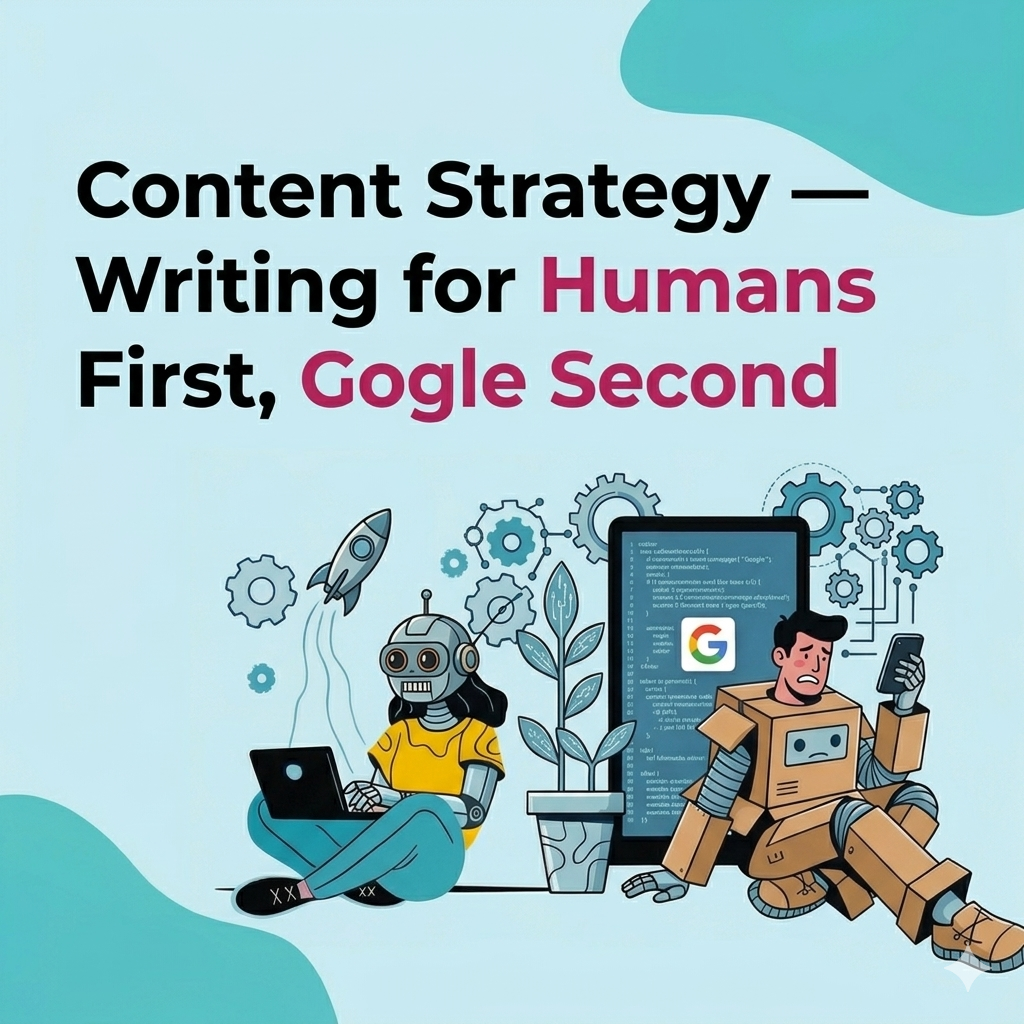
5. Content Strategy — Writing for Humans First, Google Second

Here is something worth saying clearly: Google’s job is to find the best answer for its users. So the best SEO strategy is to genuinely be the best answer. That sounds simple. In practice, it requires intentional structure.

What Makes Content Rank in 2026?

Since Google’s Helpful Content updates rolled out aggressively from 2023 onwards, one thing has become undeniable — content written to game algorithms is being systematically demoted. If your article covers the same ground as the top 10 results without adding anything original, it will struggle to rank regardless of how long it is.

Google is not just counting words anymore. It is evaluating whether your content genuinely helps the person who searched for it.

Here is what consistently works:

Go deep, not just long. A focused 1,500-word article that completely answers a question outperforms a bloated 4,000-word article that pads its way through the same points. Cover the topic thoroughly — including the follow-up questions your reader will naturally have — but cut everything that does not serve them.

Show first-hand experience. Google’s E-E-A-T framework — Experience, Expertise, Authoritativeness, Trustworthiness — explicitly rewards content that demonstrates the author has real knowledge of the subject. Share actual examples, results you have seen, tools you have personally used, or mistakes worth avoiding. Generic advice that could have been written by anyone about anything ranks below content that could only have been written by someone who genuinely knows the subject.

Structure for scanners first. Most readers scan before they read. Use H2s and H3s to break sections logically. Use bullet points for lists, tables for comparisons, and short paragraphs throughout. If a visitor cannot understand the shape of your content in 10 seconds of scrolling, you have already lost them.

Integrate content marketing and SEO. Every piece of content should target a specific keyword cluster and serve a clear search intent. Publish with purpose — not just to fill a content calendar. Content that is not mapped to a keyword and an intent is content that is unlikely to be found.

Update regularly. High-performing pages should be reviewed every 6 to 12 months. Add fresh statistics, correct outdated information, and update the published date. On fast-moving topics like SEO, AI, and digital marketing, Google actively favours recently updated content over stale articles — even if the older article once ranked well.

6.Local SEO — Getting Found by People Near You

Local SEO is a specialised branch of search engine optimisation that focuses on helping businesses appear in geographically relevant searches. If someone searches “digital marketing course in Mumbai” or “SEO services near me”, local SEO determines what shows up — including the Google Maps results (called the Local Pack) at the top of the page. Local SEO depends on proximity, relevance, and prominence — three factors Google uses to decide which local businesses appear in search results.

Even if your business is primarily online, local SEO matters. It builds trust signals, improves your Google Business Profile visibility, and can drive highly qualified leads from people actively searching in your area.

The Key Local SEO Signals

  • Google Business Profile:This is non-negotiable. Claim your listing, fill every section completely, add photos, post updates regularly, and respond to every review.
  • NAP consistency:Your Name, Address, and Phone number must be exactly identical everywhere online — your website, Justdial, IndiaMart, Sulekha, social profiles. Even small differences (St. vs Street) can hurt local rankings.
  • Local citations:Get listed on relevant Indian business directories. Consistency and volume of citations signals legitimacy.
  • Google reviews:Reviews directly impact local pack rankings. Build a system to ask every satisfied client for a Google review. Always respond — even to negative ones.
  • Local keywords:Target city-specific phrases like ‘digital marketing training in [your city]’ or ‘SEO course [city]’. Create dedicated location pages if you serve multiple cities.
  • Google Maps SEO:Optimise your GBP category, add services, use keywords naturally in your business description. Proximity, relevance, and prominence are the three Google Maps ranking factors.

For small businesses: SEO for small businesses does not need to compete nationally. Win locally first. Rank for ‘[your service] in [your city]’ before chasing broad terms like just ‘SEO’. The local version is far less competitive and converts better.

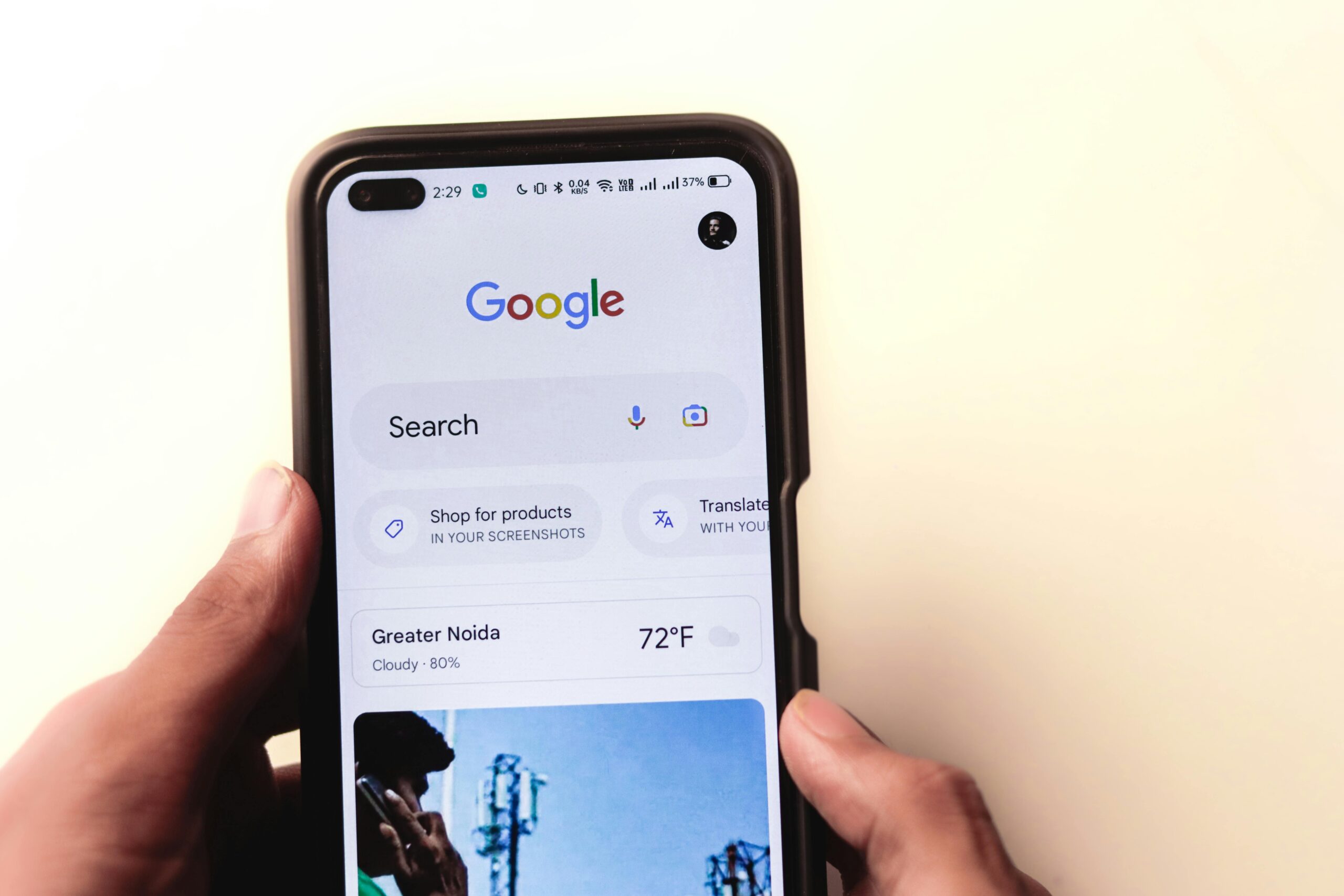
A close-up of a hand holding a smartphone with Google search displayed on the screen.

7. Essential SEO Tools — What You Actually Need

You do not need to spend a fortune on SEO tools, especially when starting out. Here are the tools that actually move the needle, organised by what they do.

Google Search Console

Monitors your rankings, clicks, crawl errors, and index coverage. Mandatory. It is free to use .

Google Analytics 4

Tracks user behaviour, traffic sources, conversions. Works with GSC. It is free to use.

Google Keyword Planner

Keyword volume and bid data. Requires Google Ads account. It is free to use.

Rankmath (WordPress)

On-page SEO guidance, schema, sitemaps. Better than Yoast for most users. It comes in free and paid version both

Ubersuggest

Keyword ideas, competitor traffic estimates, backlink data. It always certain activities for free and paid version is also available.

Screaming Frog

Crawls your site and finds technical SEO issues. Free up to 500 URLs. Both free abd paid versions are available.

SEMrush / Ahrefs

Comprehensive keyword, backlink, and competitor intelligence. Both free and paid versions are available.

Surfer SEO

Analyses top-ranking pages and tells you how to optimise content. This ia available in paid version.

Honest advice: Do not subscribe to expensive tools before you have the basics right. Start with Google Search Console + Google Analytics + a free keyword tool. Add paid tools once you have content publishing consistently and need deeper data.

8. The Future: AI SEO Optimisation, AEO, and GEO

GEO is the newest discipline — optimising your content so it gets cited by generative AI tools like ChatGPT, Google Gemini, and Claude when users ask questions in those platforms.

Think of it this way: when someone asks ChatGPT ‘what is the best way to learn SEO?’, ChatGPT answers based on what it learned during training — and what it finds via web search. Being the source that AI tools reference requires:

AI SEO Optimisation — How AI Is Changing the Game

AI SEO optimisation does not mean using AI to write your content and calling it done. It means understanding how AI tools — both the ones you use and the ones Google uses — are reshaping what 'good content' looks like. Google's AI Overviews (formerly SGE) now summarise answers directly in search results, often reducing clicks to individual pages. The content that gets cited in these AI overviews tends to be well-structured, factually accurate, and written with genuine depth. Generic content gets bypassed entirely.

AEO — Answer Engine Optimisation

Answer Engine Optimisation is the practice of structuring your content so that AI-powered answer engines — Google AI Overviews, Siri, Alexa, Bing Copilot — pull your content as the direct answer to a query. •Write in clear Q&A format where possible •Use FAQ schema markup so Google can identify and extract your answers •Answer the question in the first 2–3 sentences, then expand — do not bury the lead •Target featured snippet positions — these are the 'position zero' answers that AEO tools prioritise

  • Write in clear Q&A format where possible
  • Use FAQ schema markup so Google can identify and extract your answers
  • Answer the question in the first 2–3 sentences, then expand — do not bury the lead
  • Target featured snippet positions— these are the ‘position zero’ answers that AEO tools prioritise

GEO — Generative Engine Optimisation

GEO is the newest discipline — optimising your content so it gets cited by generative AI tools like ChatGPT, Google Gemini, and Claude when users ask questions in those platforms. Think of it this way: when someone asks ChatGPT 'what is the best way to learn SEO?', ChatGPT answers based on what it learned during training — and what it finds via web search. Being the source that AI tools reference requires:

•Building genuine topical authority — covering your subject comprehensively across multiple pages
•Publishing original data, research, or insights that other sources do not have
•Voice search optimisation — conversational, natural language content performs better in AI-generated responses
•Maintaining a strong presence on authoritative third-party platforms (LinkedIn, industry publications, forums)

The bottom line: Traditional SEO, AEO, and GEO are not competing strategies — they reinforce each other. High-quality, well-structured, authoritative content performs well across all three. The fundamentals of good SEO are becoming more important, not less.

Frequently Asked Questions

What is SEO and how does it work?

SEO (Search Engine Optimization) is the practice of improving a website so it ranks higher in search results. It works by aligning your content, site structure, and authority signals (like backlinks) with what search engines look for when deciding which pages best answer a user’s query.

What is SEO in digital marketing?

In digital marketing, SEO is the channel focused on earning free, organic traffic from search engines — as opposed to paid channels like Google Ads or social media advertising. It’s often the foundation of a marketing strategy because it drives long-term, compounding traffic without an ongoing ad spend.

What is the difference between on-page and off-page SEO?

On-page SEO covers everything you control directly on your website — content, keywords, headings, page speed, internal links. Off-page SEO covers signals from outside your site, mainly backlinks from other websites, that tell Google your content is trustworthy and worth ranking.

What is a backlink in SEO?

A backlink is a link from another website pointing to your site. Search engines treat backlinks as a vote of confidence — the more relevant, high-quality sites that link to you, the more trustworthy and authoritative your site appears in search rankings.

What is local SEO?

Local SEO is the practice of optimizing your online presence to attract customers searching in a specific geographic area — think “coffee shop near me.” It relies heavily on Google Business Profile, local citations, reviews, and location-specific keywords rather than broad national rankings.

Scroll to Top